Home News Inventory Management: 4 Warning Signs Your Distribution Operation Is Losing Control

Inventory Management: 4 Warning Signs Your Distribution Operation Is Losing Control

Every extended holiday period puts distribution systems under stress. The pattern is predictable: key SKUs run out at the point of sale while slow-moving stock accumulates in distributor warehouses. The result is a data misalignment that quietly erodes both revenue and competitive positioning.

What makes this particularly damaging is the lag. Based on deployment data recorded across HQSOFT’s client implementations, by the time losses begin appearing on financial reports, the cost of remediation is typically 3 to 5 times higher than early prevention would have required.

Drawing on 20 years of deployment experience across FMCG, Pharmaceutical, and Retail enterprises, HQSOFT has identified four critical signals that indicate a distribution system is losing inventory control.
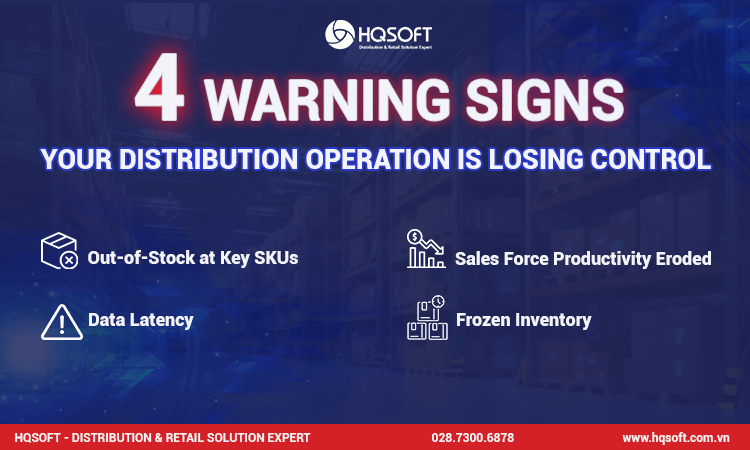
1. Out-of-Stock at Key SKUs

When end-customer demand exists but the point of sale cannot fulfill it — while distributor stock sits unallocated — the root cause is almost always an absence of forecasting infrastructure.

Underlying drivers:

  • No Safety Stock thresholds defined at the SKU level
  • Sell-out data not updated in real time
  • Stockout detection dependent on Sales visit schedules rather than automated alerts

Business impact:

  • Immediate revenue loss and shelf space surrendered to competitors
  • Consumer switching behavior triggered at the moment of unavailability

Operational indicators:

  • Sales teams frequently processing urgent replenishment orders
  • Stockouts discovered 48–72 hours after they occur

2. Data Inaccuracy and Process Latency

Misalignment between actual order data and system records leads to SKU errors, quantity discrepancies, and delayed fulfillment — all of which compound into broader operational inefficiency.

Underlying drivers:

  • Manual order entry workflows (handwritten notes, messaging apps)
  • Multiple intermediary data-entry steps, each introducing error risk

Business impact:

  • Elevated reverse logistics costs (returns, recalls, corrections)
  • Declining distributor confidence and satisfaction
  • Operational resources consumed by reconciliation rather than growth

Operational indicators:

  • Recurring distributor complaints despite repeated staff retraining
  • Error patterns that persist regardless of process adjustments

3. Frozen Inventory and Near-Expiry Risk

For industries with short product lifecycles — FMCG, F&B, Pharmaceuticals — unmonitored inventory accumulation is a direct financial liability, not merely an operational inconvenience.

Underlying drivers:

  • Procurement decisions driven by targets or intuition rather than consumption data
  • No SKU-level sell-out tracking at individual points of sale
  • Lack of Business Intelligence (BI) visibility into the Inventory Turnover Rate

Business impact:

  • Working capital tied up in non-moving stock
  • Rising disposal and write-off costs
  • Margin compression that worsens progressively

Operational indicators:

  • Inventory write-off costs appearing as a recurring line item in financial reports

4. Sales Force Productivity Eroded by Manual Tasks

When field sales representatives spend significant portions of their day on manual stock counts and expiry checks, they are not performing their primary function: market development.

Underlying drivers:

  • No digital tools available at the point of sale
  • Data capture processes that are manual and not synchronized in real time

Business impact:

  • 40–60% of productive work time redirected to non-revenue-generating tasks
  • Constrained ability to expand market coverage
  • Insufficient data quality to support meaningful performance evaluation

Operational indicators:

  • Route completion rates remain stable while new outlet acquisition flatlines

From Reactive to Proactive: Data-Driven Management with HQSOFT 360°

These four signals share a common root: the absence of an integrated, real-time data infrastructure across the distribution chain.

The HQSOFT 360° Ecosystem is built to address each failure point directly:

  • Real-Time Digitalization — Inventory and order data synchronized instantly from point of sale to central operations
  • Intelligent Alerting — Automated thresholds for Safety Stock levels and near-expiry products
  • AI-Powered Field Operations (Smart Visibility) — Image recognition for in-store inventory verification, reducing manual effort
  • BI & Data Warehouse — Enterprise-wide visibility enabling decisions grounded in Sell-in/Sell-out intelligence

Inventory control is not an operational detail — it is a direct determinant of cash flow efficiency and margin protection for any distribution-intensive business. The enterprises that compete effectively at scale are those that have moved from manual oversight to automated, data-driven operations.

Is your business exhibiting any of the warning signs above?

Schedule a consultation with an HQSOFT specialist to evaluate your current inventory control maturity and identify the highest-impact areas for optimization.

Register for Trial & Support (Đăng Ký Trải Nghiệm & Tư Vấn)

  • This field is for validation purposes and should be left unchanged.

INPUT YOUR COMMENT