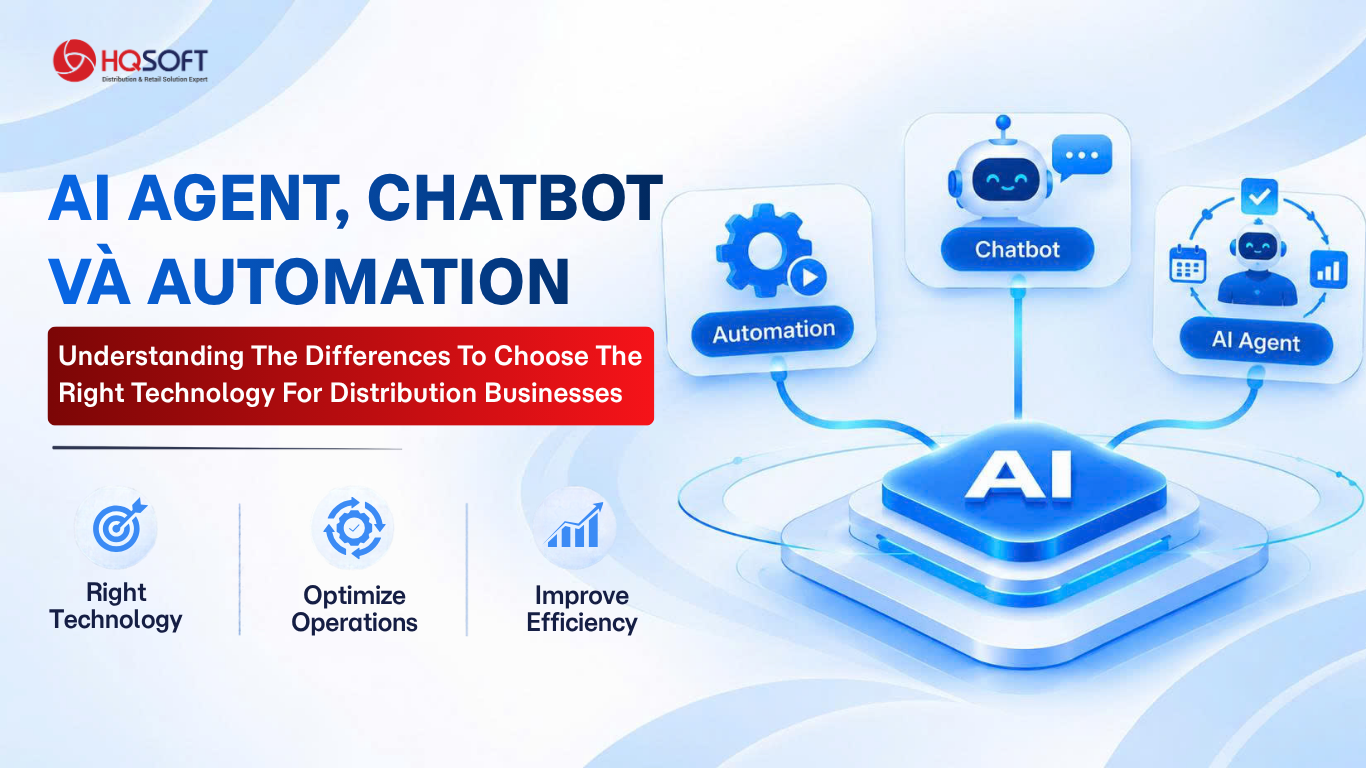
Chatbots, Automation, and AI Agents can all help businesses optimize operations, but each technology works differently and serves a distinct range of applications. Understanding these differences helps distribution businesses select solutions that meet their actual needs and assess the requirements for effective AI implementation.
An AI Agent is an artificial intelligence system that can receive a goal, gather and analyze information, then select appropriate steps to achieve that goal. Its key distinction lies not only in its ability to analyze data, but also in its capacity to proactively select tools, coordinate multiple processing steps, and take actions toward an assigned goal within its authorized scope.
Rather than simply waiting for users to ask questions and providing answers, an AI Agent can analyze a request, identify the information needed, and propose or execute a sequence of actions within its permitted scope.
For example, when a manager wants to identify which regions require priority support for the day, an AI Agent can analyze sales data, order status, target achievement, and the Sales team’s activity history. It can then identify regions showing signs of declining performance and recommend a priority order for the manager to review.
The key distinction of an AI Agent is its ability to operate based on goals and context, rather than simply delivering a response or executing a predefined action.
Although all three technologies help businesses handle tasks, Chatbots, Automation, and AI Agents differ in how they operate and their levels of autonomy.
| Criteria | Chatbot | Automation | AI Agent |
| Input | Questions or keywords | Triggering events or conditions | Goals, requests, and relevant data |
| Processing approach | Responds based on predefined scripts or configured models | Executes workflows based on predefined rules | Analyzes context and selects appropriate processing steps |
| Level of autonomy | Primarily responds to users | Automatically executes programmed steps | Can plan and execute multiple steps within its authorized scope |
| Example | Answers questions about order status | Automatically sends alerts when inventory falls below a threshold | Analyzes sales and inventory data to recommend regions requiring priority support |
In practice, these three technologies do not necessarily operate independently. A Chatbot can serve as the interaction interface, Automation can handle fixed processes, and an AI Agent can coordinate more flexible processing steps. Businesses can combine the three based on their business processes and the complexity of their needs.
To choose the right technology, businesses need to understand the functions and application scope of each solution:
Businesses should select the appropriate technology based on the complexity of each business process, rather than applying AI Agents to repetitive tasks that Automation can already handle efficiently.
To identify the right technology, businesses can start with specific operational scenarios.
1. Information Consolidation and Retrieval
When sales reps need to check order status or sales policies, a Chatbot can provide quick responses based on configured questions and information sources.
Meanwhile, when managers need to consolidate and cross-check data from multiple sources, such as sales, orders, inventory, and outlet visits, an AI Agent can perform more comprehensive analysis. Based on its assigned goal, it can identify relevant information sources, analyze relationships between datasets, and consolidate findings according to the request. This gives managers additional insight to assess business performance, identify issues, and determine priorities.
2. Data Analysis and Priority Identification
In distribution management, evaluating business performance across regions requires multiple metrics. Factors such as target achievement rates, the number of outlets generating orders, visit frequency, and product availability provide important insights into Sales team performance.
An AI Agent can help analyze and cross-check these data sources to identify regions showing signs of declining performance and determine which factors require further attention.
For example, when sales in a region decline consistently, an AI Agent can further analyze visit data, visit-to-order conversion rates, and inventory status to identify potential causes. Based on these findings, ASM/SUPs can determine which regions require closer monitoring, adjust resource allocation, and develop appropriate support plans for the Sales team.
3. Business Process Support
For processes with fixed workflows, such as automatically sending notifications when orders are confirmed or alerts when inventory falls below a specified threshold, Automation is the appropriate choice.
By contrast, when an order presents an anomaly and requires cross-checking multiple factors, such as order history, sales policies, accounts receivable, and inventory status, an AI Agent can help gather information, analyze the situation, and recommend a course of action.
Actions affecting orders, finances, or business policies must remain subject to access restrictions and approval workflows. AI can help prepare information and recommend options, but the final decision rests with the authorized person.
After identifying the business challenge and selecting the appropriate technology, businesses need to prepare the necessary conditions for effective AI adoption.
1. Define Application Objectives
Businesses need to clearly identify the issues they want to address, such as detecting regions with declining sales early or helping managers prioritize Sales team activities. The more specific the objective, the clearer the implementation scope and evaluation criteria.
2. Standardize Input Data
AI Agents require complete, consistent, and traceable data. In distribution businesses, sales, order, inventory, customer, and employee activity data need to be connected to accurately reflect operational performance.
3. Establish Access Permissions
Access should be assigned based on roles, departments, and business scope to ensure AI only accesses appropriate information. For example, ASM/SUPs should only be able to access data within their authorized management scope.
4. Build Control Mechanisms
Businesses need to clearly define which tasks AI can execute automatically, which tasks it can only recommend, and which processes require human approval. Activity logs should also be maintained for inspection and traceability when needed.
5. Define Measurement KPIs
Application effectiveness should be evaluated using specific metrics, such as reporting time, time to detect issues, information accuracy, or improvements in Sales team performance. These metrics provide a basis for determining whether the selected technology actually addresses the initial business challenge.
Effective AI adoption requires businesses to clearly define operational needs, select appropriate technologies, and establish an implementation roadmap based on the complexity of each business process. Chatbots, Automation, and AI Agents can be deployed independently or combined to optimize different stages of management workflows.
Within Xspire, Aria is an AI assistant integrated directly into business process screens. It helps users access, query, consolidate, and explain data based on their work context and authorized access scope. Rather than spending time searching across multiple screens and data sources, managers can interact with Aria to quickly understand business performance, identify issues requiring attention, and gain additional insights to support decision-making. Learn more about Aria and its capabilities in supporting distribution business management at Aria – AI Assistant for Distribution Businesses.
For distribution businesses, a synchronized data platform, standardized operational processes, and clear control mechanisms are important prerequisites for effective AI adoption. Selecting the right technology for each business process not only helps optimize investment resources but also provides a foundation for businesses to progressively improve operational efficiency and data-driven management capabilities.
related posts
Top news






 Tags: