Sales figures from the sales team, invoice data from accounting, and sales reports from distributors may not match, even when each party maintains its own records. When data is disconnected and has not been reconciled against a common basis, businesses must spend additional time verifying figures. Meanwhile, evaluating business performance and making management decisions remain difficult without a consistent view of operations. How can businesses connect data across the distribution network and improve operational control?
Why Is Distribution Data Often Inconsistent?
In many distribution businesses, operational data is stored across multiple systems:
ERP (Enterprise Resource Planning): Manages enterprise resources and business processes, including finance and accounting.
DMS (Distribution Management System): Manages distribution operations, orders, and inventory across the distribution channel.
SFA (Sales Force Automation): Supports sales force management, including outlet information and field sales activities.
Excel: Used to consolidate reports, track targets, and reconcile data from multiple sources.
Using multiple systems does not automatically lead to data discrepancies. Discrepancies arise when systems are not properly connected, data recording practices are inconsistent, or updates occur at different times.
How Does Inconsistent Data Affect Distribution Operations?
Fragmented and inconsistent data across departments can lead to several challenges:
Delayed decision-making: Management spends valuable time reconciling figures and investigating discrepancies instead of focusing on strategic analysis and operational optimization.
Limited ROI measurement: Evaluating the effectiveness of trade marketing campaigns becomes difficult when implementation costs, revenue, and outlet data are scattered across multiple systems.
Challenges in KPI reconciliation and performance evaluation: When sales figures, target achievement results, and accounting data have not been consistently reconciled, businesses must spend additional time verifying results. This affects reporting timelines and performance evaluations.
Businesses need to standardize and integrate management data to ensure information flows consistently across departments, supporting more accurate reconciliation and decision-making.
Connect Data and Strengthen Management with Xspire Business Platform
Addressing fragmented data requires more than generating additional reports. Businesses need to standardize data recording, connect information, and establish reconciliation rules across systems.
HQSOFT’s Xspire Business Platform is designed to connect sales, distribution, and business operations through a unified management platform, helping businesses improve visibility and control across their distribution networks.
To ensure data effectively supports management, businesses should focus on three key areas:
Data Standardization: Align product, customer, and distributor master data, along with related recording rules, to establish a consistent basis for data consolidation and reconciliation.
Reconciliation Rules: Define the reference data source for each business process, update schedules, and procedures for handling discrepancies.
Management Data Integration: Connect data from sales, distribution, and finance according to business requirements, enabling better cross-functional collaboration and supporting leadership decision-making.
The scope of integration and level of synchronization depend on each business’s existing systems, operational requirements, and implementation approach.
One Platform, Multiple Roles in Distribution Management
Leadership Team: Gain an overall view of business performance and financial health across the entire distribution network.
Sales Director: Closely monitor KPIs, distribution coverage, revenue, inventory, and accounts receivable by sales route, sales rep, and outlet.
Chief Accountant: Cross-check purchasing and sales data, inventory, and accounts receivable and payable within one system, reducing duplicate data entry.
Supply Chain Management (Warehouse and Procurement): Accurately monitor inventory movements and the flow of goods.
IT Department: Optimize infrastructure management resources and expand third-party integrations through standardized APIs.
In addition, Xspire includes Aria, an AI-powered assistant that supports users within the system. Aria does not make decisions on behalf of users. It only executes actions after users review and approve them. When data is consolidated into a single source, month-end review meetings can focus on decisions rather than reconciling figures.
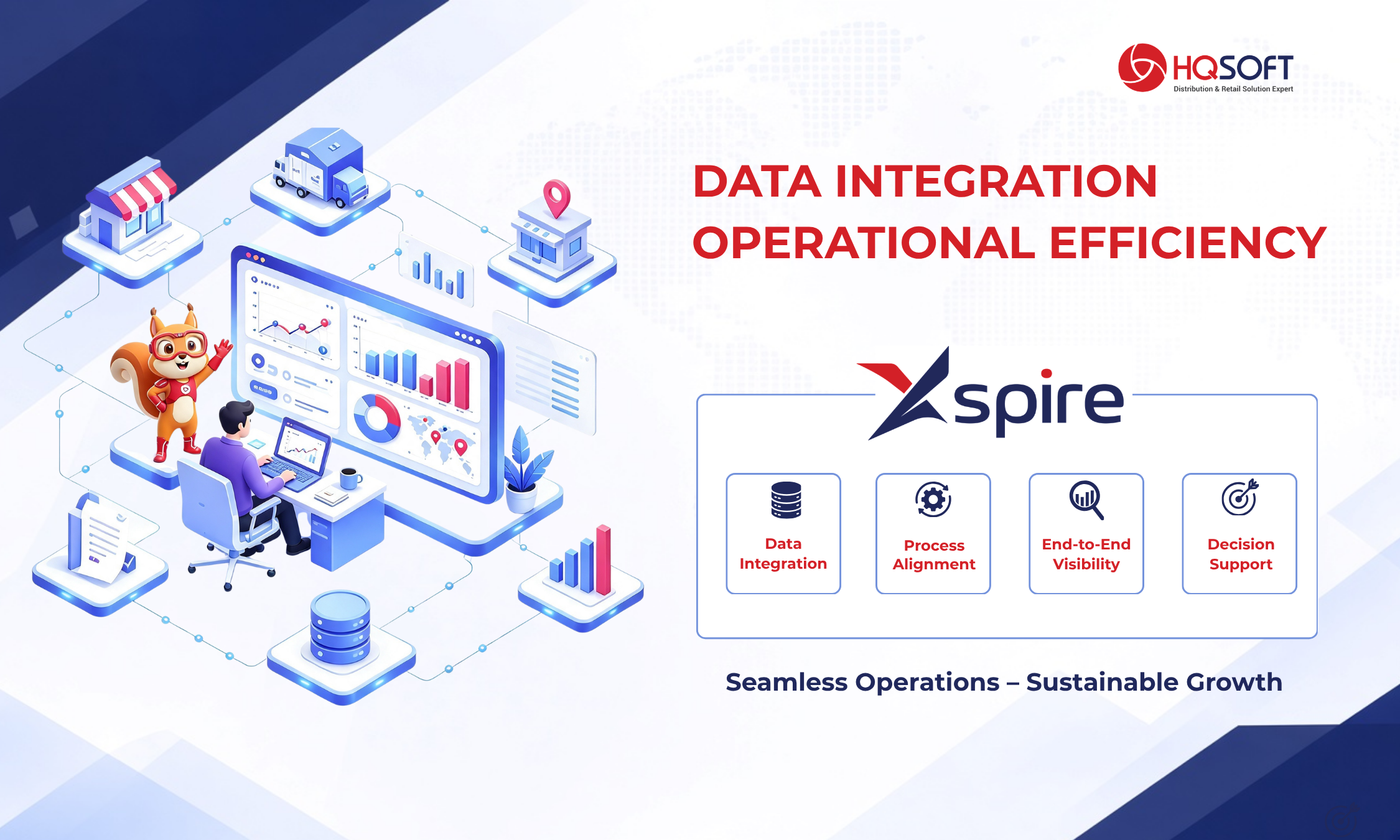
Xspire Business Platform helps integrate data and optimize operations.
Want to bring distribution data into a single source? Contact HQSOFT to schedule a consultation and demo and see how Xspire can address your business challenges.
Register for Trial & Support (Đăng Ký Trải Nghiệm & Tư Vấn)





 Tags: