The year-end peak season is when consumer demand accelerates. The challenge for distributors is how to keep products in the right place at the right time without letting inventory levels exceed manageable limits. According to supply chain management experts, stockouts can cause businesses to miss opportunities for sales growth, while excess inventory puts direct pressure on working capital and increases the risk of products remaining in storage for too long.
As orders and product flows continue to fluctuate, distributors can no longer rely on intuition alone. They need real-time, accurate system data to manage inventory effectively, enabling them to make timely adjustments and optimize product allocation.
Let’s explore 5 ways distributors can proactively control inventory and optimize product flows during the peak season, with comprehensive support from eSales Cloud DMS by HQSOFT.
From Q4 through the Tet holiday period, demand for shopping, gifting, and stockpiling increases significantly across many FMCG categories. Distributors need to ensure products reach the right place at the right time while maintaining inventory control and efficiently managing product flows. During this period, distributors commonly face three major risks:
The common factor behind these risks is that distributors lack sufficiently fast and accurate data to make timely decisions.
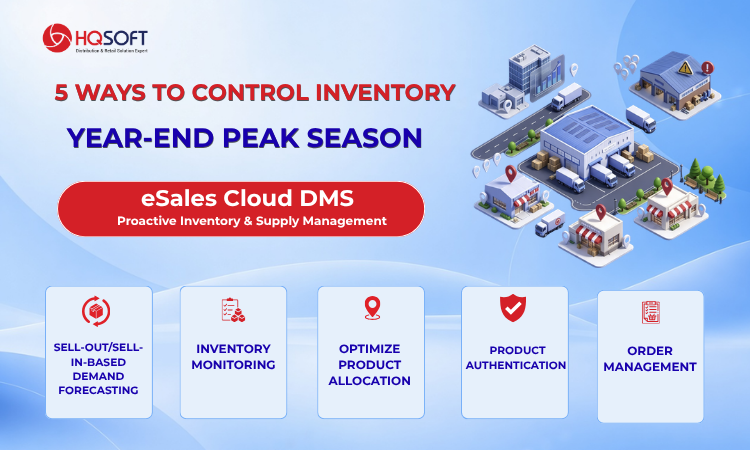
Combining Sell-in and Sell-out data helps businesses accurately assess consumption rates by product and outlet. This enables more market-aligned demand forecasting, supporting proactive replenishment planning and optimized inventory levels.
During the peak season, inbound, outbound, and stock transfer activities occur continuously. Real-time inventory data enables managers to accurately track stock quantities, locations, and inventory status, allowing them to promptly reallocate products and minimize localized shortages.
Instead of distributing products evenly, businesses can leverage MCP data, historical consumption, and outlet potential to identify demand and prioritize product allocation. This approach helps optimize allocation and improve inventory utilization.
Centralized management from order creation, verification, and approval through delivery and reconciliation helps businesses minimize discrepancies throughout the order fulfillment process. At the same time, connected data across the entire workflow enhances control as order volumes increase during the peak season.
Tracking products by batch and expiry date enables businesses to proactively identify, rotate, and handle near-expiry products. Combined with QR Code-based product authentication, this also helps control product sources and protect brand reputation across the entire distribution network.
Proactively manage inventory and product flows ahead of the peak season with eSales Cloud DMS.
Register for a consultation today and be ready to operate efficiently as market demand increases.
related posts
Top news
![[HQSOFT]-Logo-tagline](https://hqsoft.com.vn/wp-content/uploads/2023/03/HQSOFT-Logo-tagline.png)





 Tags:
Tags: